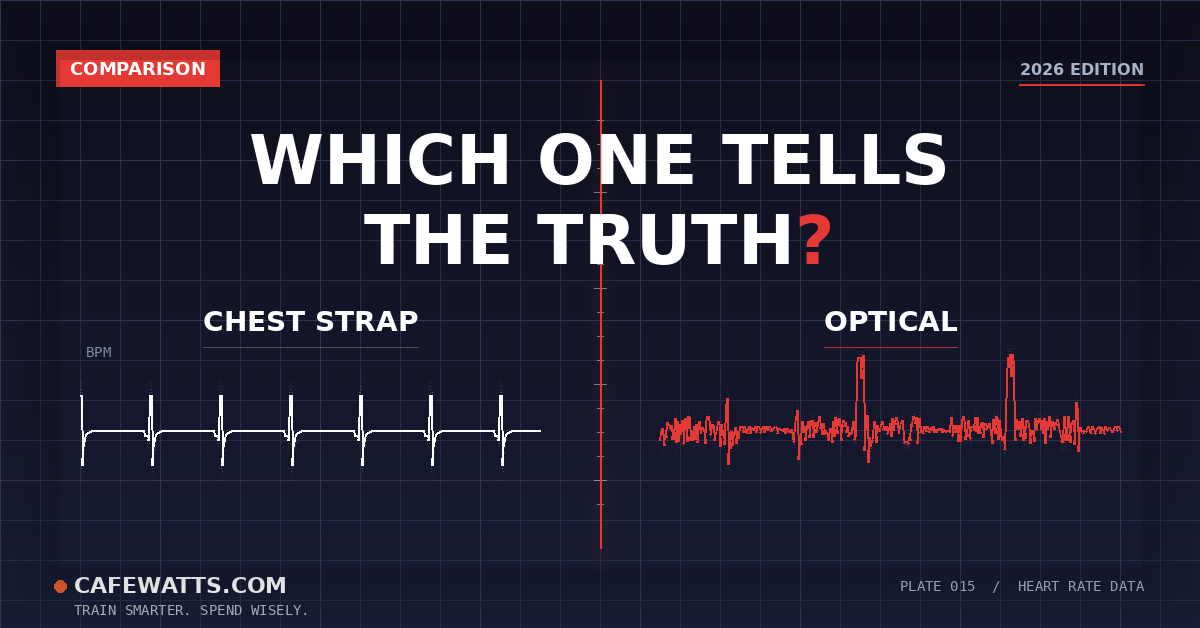
You finish a hard interval session, scroll back through the data, and the heart rate graph looks like a seismograph during an earthquake — spikes, dropouts, weird gaps where the sensor clearly lost the plot. That’s the chest strap vs optical HRM problem in one screenshot, and most riders don’t realize they’re training off bad data until they switch and see what they were missing.
Both technologies work. Both have real tradeoffs. But for serious cycling training in 2026, the right answer to the chest strap vs optical HRM question depends on what you’re actually doing on the bike.
This article contains affiliate links. If you purchase through these links, CafeWatts earns a small commission at no extra cost to you. This helps keep the site running and the coffee flowing.
⭐ Our Top Pick
Polar H10 Chest Strap HRM
The most accurate, most reliable heart rate monitor available in 2026 — whether you’re chasing watts on Zwift or grinding gravel in October.
Why Heart Rate Monitor Type Actually Matters for Cyclists
In the chest strap vs optical HRM debate, most riders treat heart rate monitors as an afterthought — grab whatever’s cheapest or most convenient and move on. But if you’re using heart rate data to drive training decisions, zone work, or recovery tracking, the difference between a chest strap and an optical HRM isn’t a minor detail. It can mean the difference between data you can train off and data that’s telling you a story that isn’t quite true.
That gap is exactly what the chest strap vs optical HRM comparison is about.
In 2026, optical heart rate technology has genuinely improved. But chest straps haven’t stood still either. Understanding the real-world strengths and weaknesses of each — not just the spec sheet talking points — is what this guide is actually about.
How Each Technology Works
Chest straps use electrocardiography (ECG) principles. Electrodes pressed against your skin detect the electrical signal your heart produces with every beat. It’s essentially the same principle as a medical ECG, just stripped down. The signal is direct and fast — no interpretation required.
Optical HRMs — whether worn on your wrist, arm, or elsewhere — use photoplethysmography (PPG). LEDs shine light into your skin, and sensors detect changes in blood flow as your heart pumps. It’s measuring the downstream effect of a heartbeat, not the beat itself. That processing gap is where accuracy issues creep in, especially during intense efforts or sudden pace changes.
Side-by-Side: Chest Strap vs Optical HRM 2026
Here’s the chest strap vs optical HRM comparison stripped down to the factors that actually drive a buying decision.
| Factor | Chest Strap | Optical HRM |
|---|---|---|
| Measurement | ECG (electrical signal) | PPG (light + blood flow) |
| Accuracy, steady-state | Excellent | Very good |
| Accuracy, intervals & sprints | Best-in-class | Noticeable lag (10–15s) |
| Cold-weather performance | Unaffected | Drops with poor circulation |
| Motion artifact | Minimal | Rough terrain adds noise |
| Comfort | Adjustment period | Set-and-forget |
| Connectivity | ANT+ and Bluetooth | Bluetooth (usually) |
| Battery | 1+ year on coin cell | Days; needs charging |
| Typical price | $80–$130 | $60–$100 |
| Best for | Intervals, racing, zone work | Endurance, all-day tracking |
Chest Strap HRMs: The Honest Take
On the chest strap vs optical HRM split, chest straps remain the gold standard for accuracy in 2026, full stop. If you’re doing structured interval work, racing on Zwift, or trying to dial in heart rate zones with any precision, a chest strap is the right tool.
The Polar H10 is the benchmark. After spending time with it across indoor training sessions and outdoor rides, the consistency is genuinely impressive. Beat-to-beat accuracy, fast response to intensity changes, Bluetooth and ANT+ dual connectivity, and a battery that lasts long enough that you forget it needs replacing. For a full honest breakdown, check out the Polar H10 Review 2026.
Chest Strap Pros
- Best-in-class accuracy: ECG-based measurement responds immediately to intensity changes — critical for interval work where optical sensors can lag by several seconds or more.
- Reliable in cold weather: Cold hands, poor circulation, heavy clothing — none of these affect chest strap readings. Optical sensors struggle in exactly these conditions.
- Works seamlessly with training platforms: ANT+ and Bluetooth support means clean integration with Zwift, TrainerRoad, Garmin, and Wahoo devices without dropouts or pairing headaches.
- No motion artifact: Running cadence, rough gravel, or high-cadence sprinting — none of it introduces noise into the data the way movement does with optical sensors.
Chest Strap Cons
- Comfort takes adjustment: Some riders never fully love wearing a strap across their chest, especially on long rides. Electrode gel drying out mid-ride is a real thing, and skin irritation can happen over time.
- One more thing to remember: You have to put it on deliberately. Optical sensors built into a watch or armband are always there — chest straps require intentional setup before every ride.
Optical HRMs: The Honest Take
On the chest strap vs optical HRM split, optical heart rate monitors have improved significantly. In 2026, a quality armband optical HRM like the Wahoo TICKR Fit can deliver solid data for steady-state riding, endurance pace work, and general training. If your rides are mostly aerobic and you’re not chasing precise interval data, optical is a genuinely usable option.
Where optical sensors still fall short: rapid intensity changes. Sprint efforts, VO2 intervals, and hard accelerations create lag — sometimes 10-15 seconds or more — before the optical sensor catches up to what your heart is actually doing. That’s not a flaw in a specific product; it’s a fundamental limitation of how the technology works.
On any chest strap vs optical HRM comparison, wrist-based optical HRM (built into smartwatches or cycling computers) tends to perform worse than armband optical HRMs for cycling specifically. Blood flow to the wrist is lower, and wrist movement during riding introduces additional noise. An armband positioned higher on the forearm gets better perfusion and a more stable signal.
Optical HRM Pros
- Effortless convenience: Slip it on and go. No electrode gel, no strap adjustment, no forgetting it in your kit bag. For casual riding or when simplicity matters, optical wins on friction alone.
- Comfortable for all-day wear: If you’re tracking recovery heart rate, HRV trends, or resting HR throughout the day, an optical wearable is far more practical than wearing a chest strap for 24 hours.
- Good enough for steady riding: For endurance rides, long Z2 sessions, or general fitness tracking, modern optical sensors are accurate enough that most riders won’t notice a meaningful difference.
Optical HRM Cons
- Lagging accuracy during intervals: The signal delay during high-intensity efforts is a real problem for structured training. If your workout depends on knowing your HR is in Zone 5, optical may still be showing Zone 4.
- Cold weather performance drops: Reduced peripheral blood flow in cold conditions — exactly the conditions many Minnesota riders deal with — degrades optical sensor accuracy noticeably.
- Motion artifact on rough terrain: Gravel, cobbles, and technical trail riding all introduce noise into optical readings. The harder and rougher the riding, the less reliable the data.
Chest Strap vs Optical HRM: Which One Do You Actually Need?
The chest strap vs optical HRM choice depends almost entirely on how you train.
If you’re doing structured interval work — whether that’s Zwift workouts through a Minnesota winter basement session or threshold efforts outdoors — a chest strap is worth every penny of the extra cost. The accuracy difference is real and it affects training quality. The Polar H10 at approximately ~$105 is the obvious pick here. It’s what I reach for when the data actually matters.
For a detailed look at a strong chest strap alternative, the Garmin HRM 600 Review 2026 is worth reading before you decide.
If you’re riding for fitness, logging aerobic base miles, or just want to keep a general eye on effort without obsessing over zone precision, a quality optical armband like the Wahoo TICKR Fit at approximately ~$80 does the job with far less hassle. For a full breakdown of how it performs in real riding, check the Wahoo TICKR Fit Review 2026.
If you’re using heart rate data alongside power meter data on Zwift or for outdoor training, pair a chest strap with your setup. Heart rate and power together tell a complete story — but only if the heart rate side of the equation is accurate.
That’s where the chest strap vs optical HRM choice quietly shapes outcomes. For context on the indoor training side of this setup, the Zwift Setup Guide for Beginners 2026 is a solid starting point.
The Bottom Line on Chest Strap vs Optical HRM in 2026
The chest strap vs optical HRM verdict in 2026 lands in a familiar place: optical HRM technology is better than it’s ever been, and for a lot of riders it’s genuinely good enough.
But chest straps are still more accurate, more reliable in adverse conditions, and better suited to anyone doing serious structured training. The price gap between a quality optical armband and a quality chest strap is small enough that if accuracy matters to you at all, the chest strap is the easy call.
In any chest strap vs optical HRM comparison, accuracy wins for serious training. Grab the Polar H10 if you want the best. It’s the one that earns its spot in serious training setups and doesn’t ask you to second-guess your data.

I’ve been riding seriously since my late 20s, and when you live up in northern Minnesota, the roads disappear under snow for months — so you figure out indoor training pretty fast. That’s how I fell down the rabbit hole of smart trainers, cycling computers, and all the gear that makes basement miles actually worth doing. I’ve spent a lot of dark mornings testing what works and cutting through the marketing fluff so you don’t have to. That’s what CafeWatts is — honest takes from someone who actually rides the stuff.