Twenty minutes into a Zwift Zone 2 ride, the heart rate graph spikes to 178 for no reason and then drops back to 142 like nothing happened. If you’ve ever stared at that ghost spike and wondered whether your training data was even real, you already know why the best heart rate monitors for Zwift matter.
Power from your smart trainer tells part of the story. But heart rate fills in the gaps — how hard your body is actually working, whether you’re recovered, whether that Zone 2 ride is actually Zone 2. A bad HRM doesn’t just give you bad numbers. It gives you false confidence in your training decisions.
Finding the best heart rate monitors for Zwift in 2026 doesn’t have to be complicated, but there are real differences between what’s out there — accuracy, connectivity, comfort during long indoor sessions, and whether the thing actually stays connected when you’re 45 minutes into a hard interval block and sweating through everything.
This article contains affiliate links. If you purchase through these links, CafeWatts earns a small commission at no extra cost to you. This helps keep the site running and the coffee flowing.
⭐ Our Top Pick
Polar H10
The most accurate chest strap HRM you can buy for Zwift in 2026 — reliable ANT+ and Bluetooth, rock-solid signal, and built to handle serious sweat.
Why Heart Rate Monitoring Matters for Zwift
Looking at the best heart rate monitors for Zwift means understanding why indoor training is different from outdoor riding in one important way: you can’t fake recovery. Outside, you can soft-pedal a climb, draft a wheel, freewheel a descent. On Zwift, the numbers are right there in front of you. If your HRM is spiking to 185 when you’re doing easy endurance work, something’s wrong — either with your fitness, your pacing, or your sensor.
For structured Zwift training — intervals, training plans, racing — accurate heart rate data helps you understand what your power numbers actually mean for your body on any given day. Pair one of the best heart rate monitors for Zwift with a quality smart trainer and you’ve got a genuinely useful feedback loop. If you’re still figuring out your indoor setup from scratch, the Smart Trainer Buying Guide is a good place to start before diving into accessories.
Another consideration when picking from the best heart rate monitors for Zwift: indoor sessions produce a lot of sweat. Optical wrist-based sensors struggle with motion artifacts and sweat saturation during high-intensity efforts. Chest straps generally win on accuracy for hard efforts. Arm-based optical HRMs sit somewhere in between. All three options are covered below.
Best Heart Rate Monitors for Zwift 2026: The Picks
1. Polar H10 — Best Overall for Accuracy
In any list of the best heart rate monitors for Zwift, the Polar H10 is the standard that everything else gets measured against. After spending time with this sensor across extended training blocks, it’s hard to argue with the consistency. The H10 uses electrocardiography — the same method as a medical-grade chest monitor — which puts it in a different accuracy class than optical sensors.
For Zwift specifically, the H10 transmits over both ANT+ and Bluetooth simultaneously, which means it can talk to Zwift on your tablet or PC while also feeding data to a Garmin or Wahoo computer if you’re running one. That dual-transmission capability matters more than most riders realize until they try to run multiple devices.
The strap has built-in memory to store one workout session offline, and it’s waterproof to 30 meters — overkill for Zwift, useful if you swim cross-train. Battery life runs approximately 400 hours on a single CR2025. The electrode strap is replaceable, so you’re maintaining rather than replacing the entire unit when it wears out.
| Spec | Polar H10 |
|---|---|
| Sensor Type | Chest strap (ECG) |
| Connectivity | ANT+ and Bluetooth (dual simultaneous) |
| Battery Life | ~400 hours |
| Water Resistance | 30 meters |
| Onboard Memory | Yes (1 session) |
| Price | ~$105 |
Pros:
- Best-in-class accuracy for any intensity level, including hard intervals
- Simultaneous ANT+ and Bluetooth — connects to Zwift and a GPS computer at the same time
- Replaceable strap means long-term value
- Solid connection stability through long, sweaty indoor sessions
Cons:
- Requires moistening the electrodes before a workout — easy to forget, causes dropout if you skip it
- ~$105 is more than budget options, though accuracy justifies it for serious training
Who should buy this: Any Zwift rider doing structured training, intervals, or racing who needs heart rate data they can actually trust. The H10 is the right answer for anyone treating Zwift as a real training tool rather than casual spinning. If you want a deeper breakdown of this sensor, the full Polar H10 Review 2026 covers it in detail.
2. Polar H9 — Best Value Chest Strap
Among the best heart rate monitors for Zwift on a budget, the Polar H9 is the H10’s more affordable sibling. For straightforward Zwift use, it covers the bases well. You lose the onboard memory and the simultaneous dual-device connection — the H9 connects to one Bluetooth device at a time, plus ANT+. For most riders running Zwift on a single screen without a separate GPS unit, that’s a non-issue.
Accuracy is excellent for the price, and it uses the same ECG-based sensing method as the H10. Battery life runs approximately 400 hours as well. If the H10 feels like more sensor than you need, the H9 is the smart step down without sacrificing meaningful accuracy.
| Spec | Polar H9 |
|---|---|
| Sensor Type | Chest strap (ECG) |
| Connectivity | ANT+ and Bluetooth (single BT device) |
| Battery Life | ~400 hours |
| Onboard Memory | No |
| Price | Check current price on Amazon |
Pros:
- ECG-level accuracy at a lower price than the H10
- ANT+ and Bluetooth connectivity — compatible with Zwift and most platforms
- Reliable signal through hard efforts and heavy sweat
Cons:
- Single Bluetooth connection only — can’t broadcast to Zwift and a cycling computer simultaneously
- No onboard memory for standalone workout recording
Who should buy this: Riders who want chest strap accuracy without paying for features they won’t use. If you’re running Zwift on a single device and not pairing to a head unit simultaneously, the H9 hits the sweet spot.
3. Wahoo TICKR Fit — Best Optical Option for Zwift
On any list of the best heart rate monitors for Zwift, the TICKR Fit is Wahoo’s optical armband entry. and it’s worth considering if you find chest straps uncomfortable or if you want something you can clip on and forget. After spending time with this sensor during indoor sessions, the accuracy is solid at moderate intensities — steady-state riding, endurance work, tempo efforts.
Where optical HRMs including the TICKR Fit can struggle is during rapid intensity changes — like punchy interval work or Zwift sprint segments. The optical sensor has a slight lag compared to ECG chest straps. That said, for most Zwift riders doing endurance-focused training or casual rides, it’s more than capable.
ANT+ and Bluetooth connectivity cover all the standard Zwift setups, and the armband mount is comfortable for long sessions. Battery life runs approximately 30 hours per charge via USB.
| Spec | Wahoo TICKR Fit |
|---|---|
| Sensor Type | Optical armband |
| Connectivity | ANT+ and Bluetooth |
| Battery Life | ~30 hours |
| Charging | USB |
| Price | ~$80 |
Pros:
- No chest strap — easy on/off, comfortable for long indoor sessions
- ANT+ and Bluetooth connectivity for full Zwift compatibility
- Good accuracy at steady-state and moderate intensities
- USB rechargeable — no battery swapping
Cons:
- Optical lag during rapid intensity changes — less precise during sprint intervals or VO2 work
- Sweat can occasionally affect signal quality during very long, intense sessions
Who should buy this: Zwift riders who want a chest-strap-free option and do primarily endurance or tempo work. If you’re doing a lot of high-intensity intervals or Zwift racing where precise HR response matters, upgrade to a chest strap. Full details in the Wahoo TICKR Fit review.
4. COOSPO HRM — Best Budget Pick
If budget is the primary constraint, the COOSPO chest strap earns its place among the best heart rate monitors for Zwift in 2026. It covers ANT+ and Bluetooth connectivity, uses ECG-based sensing, and pairs reliably with Zwift. It doesn’t have the build quality or refinement of the Polar options, but for riders who just want a working HRM without paying $100+, it delivers on the basics.
Pros:
- ANT+ and Bluetooth — Zwift compatible out of the box
- ECG chest strap accuracy at a budget price
- Reliable for steady-state and moderate-intensity training
Cons:
- Build quality and strap comfort don’t match the Polar H9/H10
- Occasional dropout reported during very high-sweat sessions
Chest Strap vs Optical: What Actually Matters for Zwift
Across the best heart rate monitors for Zwift, the honest answer is that chest straps win on accuracy, especially for hard efforts. If you’re doing structured interval work — the kind of training that actually moves your fitness — you want ECG data, not optical. The lag and accuracy issues with optical sensors during high-intensity work aren’t theoretical. They show up in your training data.
That said, if your Zwift riding is mostly endurance riding when picking from the best heart rate monitors for Zwift, virtual group rides, or casual exploration, an optical option like the TICKR Fit is genuinely fine. For a deeper dive on this topic, the chest strap vs optical HRM guide breaks down the tradeoffs in detail.
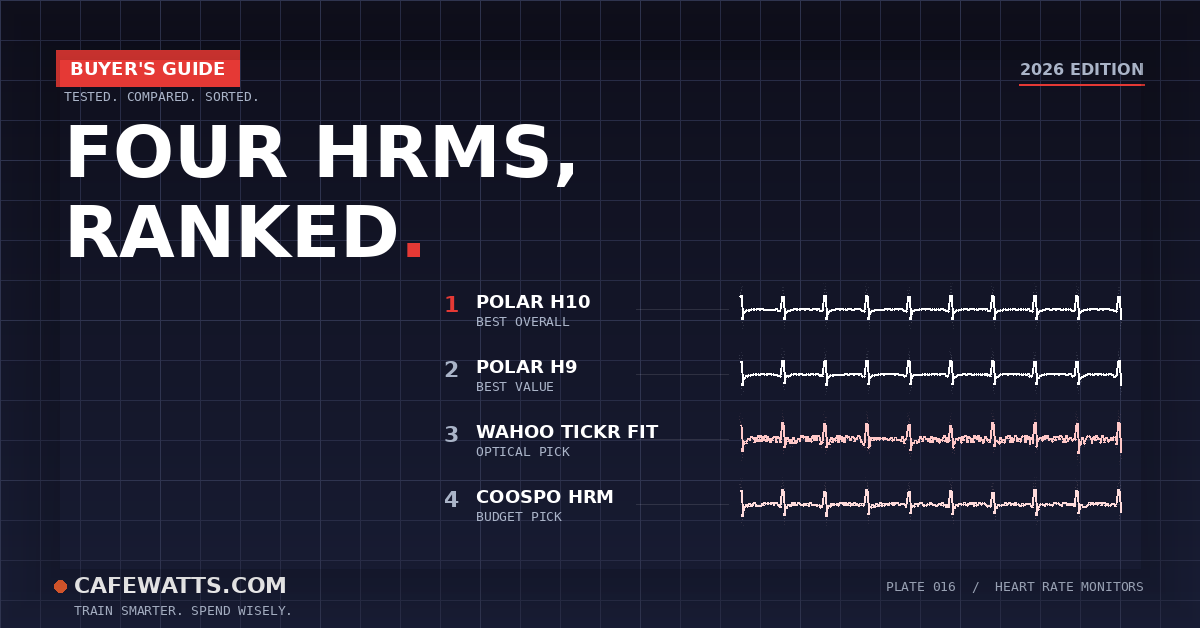
Quick Comparison: Best Zwift HRMs 2026
| Monitor | Type | Connectivity | Best For | Price |
|---|---|---|---|---|
| Polar H10 | Chest (ECG) | ANT+ + BT (dual) | Best overall accuracy | ~$105 |
| Polar H9 | Chest (ECG) | ANT+ + BT (single) | Best value chest strap | Check Amazon |
| Wahoo TICKR Fit | Optical (arm) | ANT+ + BT | No chest strap comfort | ~$80 |
| COOSPO HRM | Chest (ECG) | ANT+ + BT | Budget riders | Check Amazon |
The Bottom Line
Among the best heart rate monitors for Zwift in 2026, the Polar H10 is the right call for most riders who are serious about training. The accuracy advantage over optical sensors is real, the dual Bluetooth plus ANT+ transmission is genuinely useful, and at approximately $105 it’s not a significant investment compared to what most people spend on smart trainers and subscriptions. If you’re already running a Wahoo KICKR or similar setup and paying for Zwift monthly, the HRM is the last place to cut corners on data quality.
If budget is tight, the Polar H9 gives you most of the H10’s accuracy at a lower price. The TICKR Fit is the right call if chest straps are a dealbreaker for you and your training isn’t heavily interval-based. And if you’re brand new to Zwift and just want something that works while you figure out your setup, the COOSPO gets the job done without breaking the bank.
Whatever you pick from the best heart rate monitors for Zwift list, accurate heart rate data makes your Zwift training smarter. Pair it with the right trainer and you’ve got a legitimate indoor training setup — not just a way to burn time until the roads clear up again.

I’ve been riding seriously since my late 20s, and when you live up in northern Minnesota, the roads disappear under snow for months — so you figure out indoor training pretty fast. That’s how I fell down the rabbit hole of smart trainers, cycling computers, and all the gear that makes basement miles actually worth doing. I’ve spent a lot of dark mornings testing what works and cutting through the marketing fluff so you don’t have to. That’s what CafeWatts is — honest takes from someone who actually rides the stuff.