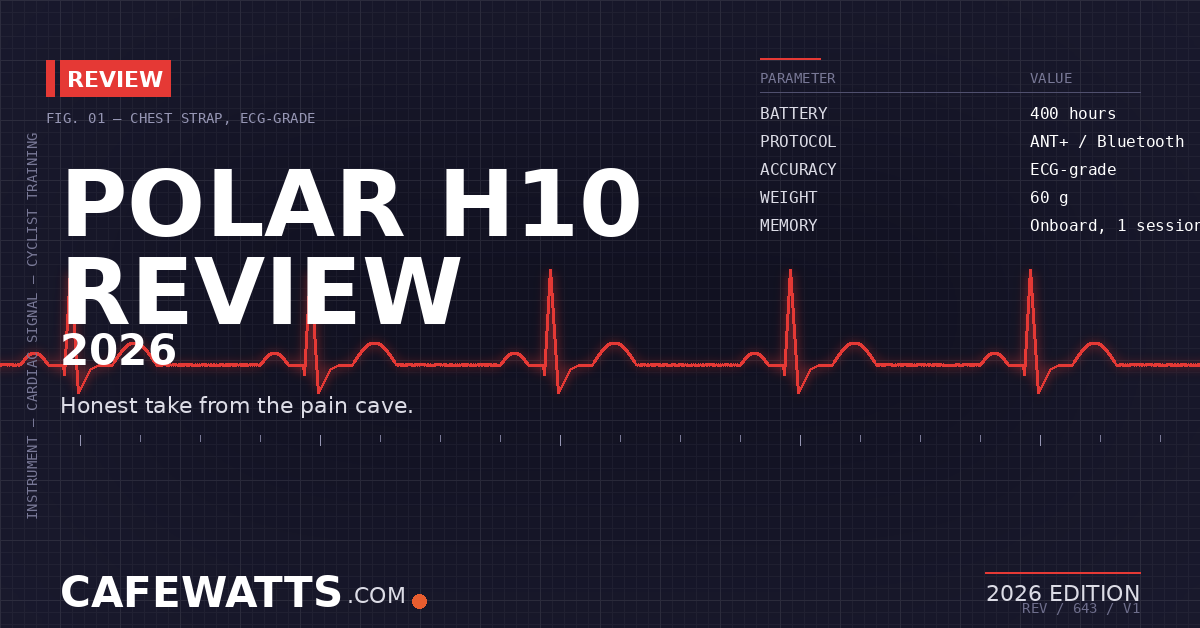
Here’s a question worth asking before you spend money on a heart rate monitor: how accurate does it actually need to be? Because if you’re training with power and using heart rate as a secondary metric, a mediocre chest strap might be fine. But if heart rate is your primary training signal — or you’re pairing it with a smart trainer for structured intervals — accuracy isn’t optional. That’s where the Polar H10 review conversation always ends up, and for good reason.
This article contains affiliate links. If you purchase through these links, CafeWatts earns a small commission at no extra cost to you. This helps keep the site running and the coffee flowing.
⭐ Our Top Pick
Polar H10 Heart Rate Monitor
The most accurate chest strap HRM available in 2026 — trusted by serious cyclists, coaches, and labs for a reason.
Who Actually Needs the Polar H10 in 2026?
Every Polar H10 review eventually has to answer this question honestly. After spending time with the Polar H10 across structured indoor sessions and longer outdoor efforts, one thing becomes obvious: this is not a casual fitness tracker accessory. The H10 is a serious piece of kit aimed at riders who actually care what their heart is doing during a threshold block or a VO2 effort on Zwift. If that’s you — if heart rate zones matter to your training — this is the monitor that holds up under scrutiny.
It pairs over both Bluetooth and ANT+, which means it works seamlessly with Garmin and Wahoo cycling computers, smart trainers, and platforms like Zwift and TrainerRoad simultaneously. That dual-protocol connectivity is more useful than it sounds. You can broadcast to your Garmin Edge on the handlebars and your trainer app at the same time without any workarounds.
Polar H10 Specs at a Glance
| Spec | Detail |
|---|---|
| Connectivity | Bluetooth + ANT+ |
| Simultaneous connections | Up to 3 Bluetooth devices |
| Battery life | ~400 hours (replaceable CR2025) |
| Internal memory | Yes — stores one training session |
| Water resistance | IPX7 (waterproof to 30m) |
| Sensor electrodes | Wet/dry electrodes |
| App compatibility | Polar Flow, Zwift, TrainerRoad, Garmin, Wahoo |
| Price | ~$105 |
What Makes the Polar H10 Different
No Polar H10 review is complete without the actual specs. The Polar H10 uses electrocardiography — the same fundamental technology as medical-grade ECG sensors — to measure heart rate directly from electrical signals in your chest. That’s fundamentally different from optical sensors on your wrist, which estimate heart rate using light reflected off your skin. During steady aerobic efforts, wrist-based monitors often perform fine. But the moment you hit a hard acceleration, a punchy sprint, or a rapid recovery between intervals, optical sensors lag. The H10 doesn’t lag. It reads what’s actually happening in real time.
That matters a lot for interval training. If you’re doing VO2 max work on Zwift or structured blocks through TrainerRoad, knowing your actual heart rate response — not a ten-second delayed approximation — changes how you interpret the session. You can see how quickly your heart rate climbs to target zone, how fast it recovers, and whether you’re actually overreaching before you blow yourself apart.
The internal memory feature is a nice touch too. The H10 can record a session independently without any connected device — useful for open-water swimming, gym sessions, or any time you don’t want your phone or computer nearby. Sync it later through the Polar Flow app.
Real-World Performance: Indoor and Outdoor
Specs only carry a Polar H10 review so far — the real test is whether the data holds up under pressure. In testing across basement Zwift sessions and outdoor road miles, the H10’s signal stability stands out. There’s no dropout, no spike anomalies, and no frustrating moment where your training app shows 210 BPM because the sensor lost contact mid-interval. That kind of reliability sounds basic, but cheaper chest straps fail here regularly.
The strap itself is soft and comfortable for a chest HR monitor — not something every rider says about chest straps. During long efforts it stays put without digging in or sliding. Wetting the electrodes slightly before putting it on improves initial signal pickup, especially in dry conditions. Once you’re sweating, it reads clean without any extra fussing.
Pairing with a Garmin Edge or Wahoo ELEMNT computer is instant. No hunting through Bluetooth menus, no re-pairing headaches. It just connects. The ANT+ signal is rock solid even in a basement pain cave environment where Bluetooth can occasionally get flaky from other devices. The pattern in any honest Polar H10 review is the same: it just disappears into the background and lets you ride.
Pros and Cons
Pros
- Best-in-class accuracy: ECG-based measurement with no lag — genuinely the most accurate consumer HR chest strap available in 2026.
- Dual Bluetooth + ANT+: Connects to multiple devices simultaneously, including Garmin, Wahoo, and training apps at the same time.
- Long battery life with user-replaceable battery: ~400 hours on a CR2025 that you swap yourself — no charging cables, no battery anxiety.
- Internal memory: Records sessions independently without a paired device, which is genuinely useful for swim or gym sessions.
- Waterproof to 30m: Handles rain, sweat, and open-water swimming without concern.
Cons
- Chest strap fit isn’t for everyone: Some riders — especially on shorter indoor sessions — find chest straps uncomfortable or fiddly. If you hate wearing anything across your chest, no amount of accuracy changes that.
- No wrist-based convenience: You have to actually remember to put it on before a ride. It sounds trivial until you’re three minutes into a warm-up and realize you left it hanging in the pain cave.
- ~$105 price point: For what it does, it’s fair value — but budget-conscious riders can find functional alternatives for less.
No honest Polar H10 review skips the downsides. Check Price on Amazon
Polar H10 vs Wahoo TICKR Fit
Any practical Polar H10 review has to address the obvious alternative. The obvious alternative at a lower price is the Wahoo TICKR Fit at ~$80, which is an optical armband monitor rather than a chest strap. The TICKR Fit is genuinely convenient — no chest strap, just slap it on your upper arm — and for steady-state aerobic riding it performs reasonably well. But in testing, the gap opens up clearly during high-intensity efforts. The TICKR Fit lags on hard accelerations and shows more signal noise during intense intervals.
If your training is mostly zone 2 and you want something less fiddly, it’s a legitimate option. If you’re doing structured intensity work where real-time accuracy actually changes decisions, the H10 wins without question.
There’s also the Polar H9 as a step-down option within Polar’s own lineup. The H9 drops to a single Bluetooth connection (no simultaneous multi-device) and loses the internal memory. For most recreational riders that’s fine. But for anyone connecting to both a cycling computer and a training app at the same time — which is common in a smart trainer setup — the H10’s multi-connection capability is worth the price difference. If a Polar H10 review feels like an obvious win here, it should — the chest strap simply collects cleaner data for serious training.
How It Fits Into a Smart Trainer Setup
A Polar H10 review aimed at indoor riders has to look at the trainer side of things too. If you’re running a Zwift or TrainerRoad setup on a smart trainer, the Polar H10 in 2026 is one of the cleanest additions you can make.
Heart rate data synced in real time to your training platform gives you a clearer picture of training stress and recovery — especially when combined with power data from the trainer itself. Platforms like Zwift display heart rate live on screen, and having accurate real-time data versus a lagging optical estimate changes how you read your efforts mid-ride.
For more on building out a complete indoor setup, the Zwift Setup Guide for Beginners 2026 covers what you actually need and in what order to buy it. And if you’re still working out which accessories make the most difference for indoor riding, the guide on Best Cycling Accessories for Zwift 2026 breaks it all down honestly.
Who Should Buy the Polar H10
The honest closer to this Polar H10 review: it depends on what you ride and how. The Polar H10 in 2026 is the right choice for riders who use heart rate as a real training tool — not just a number to glance at. If you’re following structured training plans, doing interval work on a smart trainer, or working with a coach who reviews your HR data, the accuracy difference between this and a cheaper optical monitor matters.
It’s also the right call for triathletes who need a waterproof monitor that works across swim, bike, and run without swapping devices. At ~$105, it’s not the cheapest option on the shelf — but it’s the one that doesn’t make you question your data.
Check Price on Amazon That is the most useful frame for any Polar H10 review aimed at regular riders.

I’ve been riding seriously since my late 20s, and when you live up in northern Minnesota, the roads disappear under snow for months — so you figure out indoor training pretty fast. That’s how I fell down the rabbit hole of smart trainers, cycling computers, and all the gear that makes basement miles actually worth doing. I’ve spent a lot of dark mornings testing what works and cutting through the marketing fluff so you don’t have to. That’s what CafeWatts is — honest takes from someone who actually rides the stuff.